End of Day Forex Trading Strategy: A 30-Minute Daily Workflow
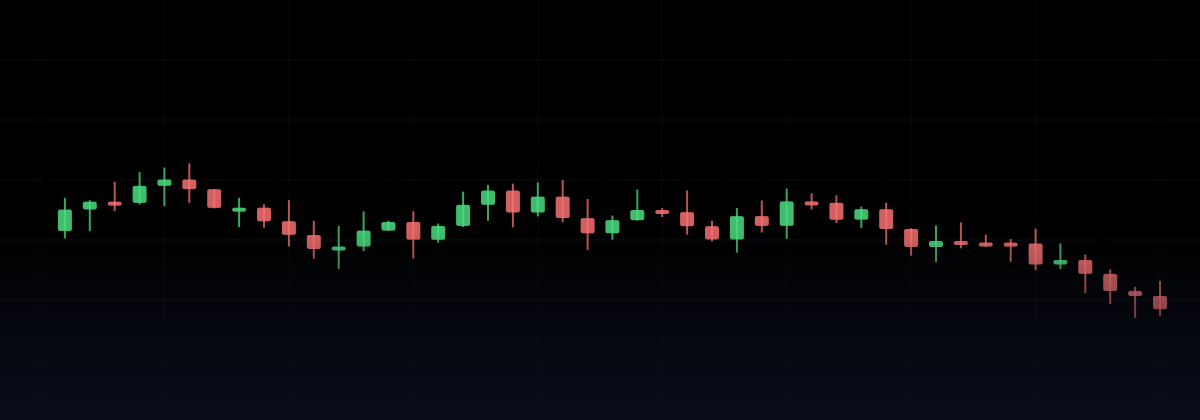
An end of day forex trading strategy means you analyse charts and place orders once per day, shortly after the daily candle closes, then leave the market alone until the next close. It suits people with jobs because decisions are made on completed daily candles, stops are wider and fewer trades are taken. The trade-off is that you hold positions overnight, pay or earn swap, and must size for daily-chart stop distances of roughly 60 to 150 pips on the majors.
Key takeaways
- Most brokers close the forex daily candle at 5pm New York time, which is the reference for any end of day routine.
- The whole workflow (review, scan, plan, place orders, journal) can fit into 20 to 40 minutes once you have a fixed checklist.
- Pending orders with attached stop-loss and take-profit do the work while you are away; you do not watch intraday charts.
- Wider daily stops mean smaller position sizes, so a 1% risk on a $5,000 account is often only 0.04 to 0.08 standard lots.
- Overnight swap and weekend gaps are real costs and risks that intraday traders avoid and end of day traders accept.
- US traders face 50:1 leverage on majors and FIFO rules; Australian and most Canadian retail traders face similar or tighter caps, which suits low-frequency trading anyway.
When the forex day actually ends
Forex trades around the clock from Sunday evening to Friday evening, so "end of day" has to be defined. The industry convention is 5pm New York time (17:00 ET), when the US session winds down and before the Sydney open. Most retail brokers use this as the daily rollover, the point at which swap is charged and a new daily candle begins. Brokers who set their server clock to GMT+2 in winter and GMT+3 in summer do so precisely so that their daily candles align with that New York close and there are five daily candles a week rather than six.
For traders in North America and Australia, that close lands at convenient times:
| Location | Daily close in local time (approximate) | Practical routine window |
|---|---|---|
| New York / Toronto | 5:00pm | 5:15pm to 6:00pm, after work |
| Chicago | 4:00pm | 4:15pm to 5:30pm |
| Los Angeles / Vancouver | 2:00pm | Lunch break or mid-afternoon |
| Sydney / Melbourne | 7:00am to 9:00am depending on daylight saving in both countries | Before work |
| Perth | 5:00am to 6:00am | Early morning |
Daylight saving shifts on different dates in the US and Australia, so for a few weeks each year the Sydney time moves by an hour. A session time converter takes the guesswork out of it.
The one thing to avoid is analysing a candle that has not closed. A daily candle at 2pm New York time can look like a strong bullish engulfing pattern and finish as a doji by the close. End of day trading is built on completed information.
The 30-minute daily workflow
The advantage of this style is that it can be reduced to a fixed routine. A repeatable process matters more than any individual indicator. Here is a structure that works for most rule-based approaches:
- Review open positions (5 minutes). Did any stops or targets fill? Does any open trade need its stop moved according to your rules (for example, to break-even once price has moved 1R in your favour)? Only make changes your plan defines in advance.
- Check tomorrow's calendar (3 minutes). Look at the economic calendar for the next 24 hours. Note any central bank decision, CPI or payrolls release for currencies you hold or plan to trade.
- Scan your watchlist (10 to 15 minutes). Flip through daily charts of perhaps 8 to 15 pairs. You are looking only for setups that match your written rules, not for anything interesting.
- Plan any new trades (5 minutes). For each valid setup, write down entry, stop, target and position size before placing anything.
- Place orders (3 minutes). Use pending orders with stop-loss and take-profit attached.
- Journal (3 minutes). Screenshot each new setup and note why it qualified.
On most days the scan finds nothing, and the routine takes ten minutes. That is normal. A daily strategy on a dozen pairs might produce two to six trades a month. Traders who find this frustrating and start dropping to lower timeframes "to find more trades" usually undo the main advantage of the method.
Entry rules that work on a daily chart
End of day is a schedule, not a strategy. You still need a defined setup. These three are common because they can be judged objectively once the candle closes.
Trend pullback to a moving average
Define the trend with the 50-day and 200-day moving averages (50 above 200 and both rising for an uptrend). Wait for price to pull back to touch or close near the 20-day or 50-day average. Enter when a daily candle closes back in the trend direction, with a buy stop a few pips above that candle's high. Place the stop below the pullback low. This is a standard trend-following setup adapted to the once-a-day schedule.
Daily rejection candle at a level
Mark major horizontal levels from the weekly and daily charts. When a daily candle tests a level and closes with a long wick rejecting it (a pin bar) or engulfs the previous day's body in the opposite direction, place a pending order beyond the candle's extreme. Stop goes on the other side of the wick. The pin bar guide covers the exact candle criteria.
Breakout of a multi-day range
When a pair has spent 10 or more days in a tight range, place buy and sell stop orders just outside the range high and low. Whichever triggers, cancel the other. Stop goes back inside the range, often at its midpoint. False breakouts are common, so this setup tends to have a lower win rate with larger winners.
Stops, targets and the ATR
Daily-chart stops are wide because daily ranges are wide. EUR/USD has often had an average daily range of somewhere around 60 to 100 pips in recent years, GBP/JPY frequently well over 120. A stop tighter than about half the average daily range will be hit by ordinary noise.
The Average True Range (ATR) is the simplest tool for calibration. A common rule is a stop at 1.5 times the 14-day ATR beyond your entry structure. If EUR/USD's 14-day ATR is 72 pips, that implies roughly a 108-pip stop. The ATR stop-loss guide explains the multipliers people use and their trade-offs.
For targets, either use a fixed multiple of risk (2R is common), the next significant daily level, or a trailing stop that moves only at the end of each day. A trailing method that updates once per day fits the workflow; one that needs intraday monitoring does not.
Position sizing with wide daily stops
This is where end of day trading differs most from what beginners expect. With a 100-pip stop, a small account takes a small position.
Example: a $5,000 account risking 1% per trade can lose $50. On EUR/USD, one standard lot pip is worth $10, one mini lot $1 and one micro lot $0.10. A 100-pip stop on one micro lot loses $10. So $50 / $10 = 5 micro lots, or 0.05 standard lots. If the stop is 140 pips, it falls to about 0.035 lots. You need a broker that allows 0.01-lot increments, which most do.
| Account size | Risk at 1% | 60-pip stop (EUR/USD) | 100-pip stop | 150-pip stop |
|---|---|---|---|---|
| $2,000 | $20 | 0.03 lots | 0.02 lots | 0.01 lots |
| $5,000 | $50 | 0.08 lots | 0.05 lots | 0.03 lots |
| $10,000 | $100 | 0.16 lots | 0.10 lots | 0.06 lots |
| $25,000 | $250 | 0.41 lots | 0.25 lots | 0.16 lots |
Sizes rounded down to the nearest 0.01 lot, assuming a USD account and $10 per pip per standard lot. For pairs where USD is not the quote currency, pip value differs; use the position size calculator for the exact figure.
Because positions are small, the margin used is small too. At 50:1, 0.05 lots of EUR/USD near 1.08 (5,000 euros, about $5,400 notional) needs around $108 of margin. Leverage limits are rarely the constraint for daily traders; risk per trade is.
Overnight costs and weekend gaps
Every position open at the 5pm New York rollover is charged or credited swap, based on the interest rate difference between the two currencies plus the broker's markup. Most brokers charge three days' swap on Wednesday night to cover the weekend. A position held for two weeks pays swap on 14 calendar days. On pairs with a large rate gap, holding against the carry can cost a noticeable fraction of a typical daily-strategy profit. Check your broker's swap table and read how forex swap works before treating any pair as free to hold.
Weekend gaps are the other cost. Markets close on Friday and reopen on Sunday at whatever price the news over the weekend dictates. A pending stop triggered at the open fills at the first available price, which may be well past your level. Some end of day traders close or reduce positions before Friday's close; others accept the gap risk and size for it.
Common mistakes with end of day trading
- Checking intraday charts anyway. Watching a daily-timeframe trade on a 5-minute chart leads to closing winners early and moving stops. If you cannot avoid looking, remove the app from your phone during the day.
- Entering before the close. Acting on a half-formed daily candle undermines the whole premise.
- Using intraday-sized stops. A 25-pip stop on a daily setup is a coin flip against noise.
- Ignoring correlation. Long EUR/USD, GBP/USD and AUD/USD is effectively one large short-dollar bet. Cap total risk on correlated positions.
- Judging the method on ten trades. At a handful of trades a month, it takes a year or more to get a meaningful sample. Backtesting on historical daily charts speeds this up considerably.
These mistakes bite harder on a low-frequency method because each trade carries more weight in a small sample.
Is end of day trading right for you?
It fits people who can commit a fixed half hour at the same time each day, tolerate holding through overnight swings without intervening, and accept a slow trade count. It fits less well if you want frequent feedback or cannot stomach a 100-pip open loss on a position, even when it is sized to be only 1% of the account. Compared with a swing trading approach that may use 4-hour charts, it is more rigid in schedule but less demanding in screen time.
It does not change the odds by itself. It reduces costs per trade relative to scalping, removes most of the intraday noise, and makes the process easier to follow consistently. Whether the rules you apply have an edge is a separate question that only testing can answer.
Frequently asked questions
What time does the forex daily candle close?
For most retail brokers, the daily candle closes at 5pm New York time, which is also the point where overnight swap is applied. Brokers that run their servers on GMT+2 or GMT+3 do this so the daily close lines up with New York. If your broker uses a different server time, you may see a small Sunday candle and slightly different daily highs and lows.
How many trades does an end of day strategy take?
It depends on the rules and the watchlist size, but a daily strategy scanning 8 to 15 pairs often produces only a few trades a month. Some months produce none. A low trade count is a feature of the method, not a sign it is broken, though it does mean results take much longer to judge than on intraday systems.
Can I do end of day forex trading with a full-time job?
Yes, that is the main reason people choose it. The routine fits into 20 to 40 minutes after the daily close, and pending orders with attached stops and targets manage trades while you work. The challenge is psychological rather than practical: resisting the urge to check intraday charts and adjust trades outside your plan.
Do end of day traders pay swap fees?
Usually, yes. Any position open at the daily rollover is charged or credited swap, and most brokers apply triple swap on Wednesday nights to cover the weekend. Holding against a large interest rate differential can be expensive over several weeks. Islamic or swap-free accounts exist with some brokers but often replace swap with an administration fee.
Is end of day trading less risky than day trading?
Not automatically. It typically involves lower trading costs per trade and less exposure to intraday noise, but it adds overnight and weekend gap risk. Risk is controlled by position size relative to the stop, not by the timeframe. A daily trade risking 1% of the account carries the same planned loss as an intraday trade risking 1%.
Does FIFO affect end of day trading in the US?
It can. FIFO requires US traders to close positions in the same pair in the order they were opened, and hedging the same pair is not allowed. If you scale into a daily trade with multiple entries, your broker will close the oldest one first. Plan stops and targets per position with that in mind, or use a single position per pair.
This article is general information, not personal financial advice. Figures such as spreads, fees, leverage and rules change; confirm them with the provider and check the provider is authorised for your country of residence.