Martingale Strategy in Forex: Why Doubling Down Fails
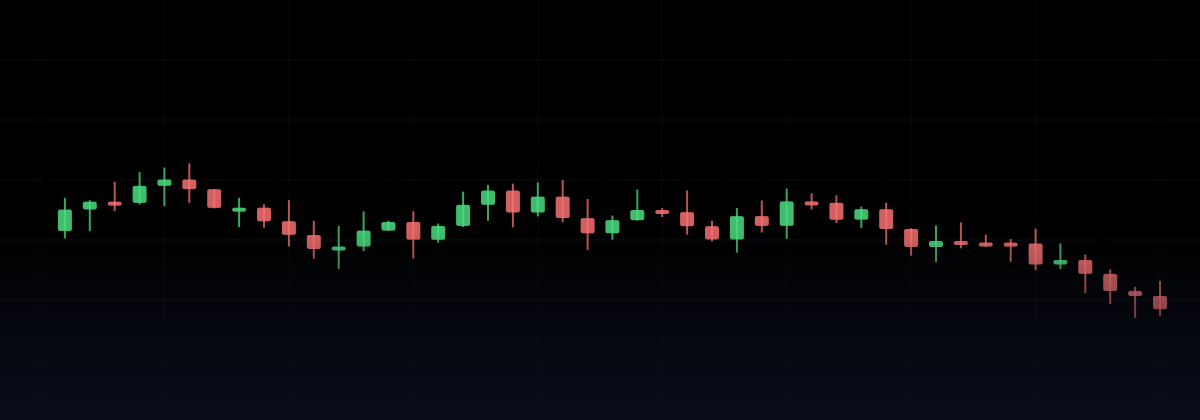
The martingale strategy doubles the position size after every losing trade so that one eventual win recovers all previous losses plus a small profit. It fails in forex for three hard reasons: losing streaks long enough to break it happen far more often than intuition suggests, position size grows exponentially until it hits your margin or the broker's limits, and doubling never changes the expected value of a trade that has no edge. It trades many small wins for a rare, catastrophic loss.
Key takeaways
- After 10 consecutive losses, a martingale that started at 0.01 lots needs 10.24 lots on the next trade, and the cumulative loss is 1,023 times the first stake.
- With a 50% win rate, a 10-loss streak somewhere in 2,000 trades is more likely than not.
- Changing position size cannot turn a strategy with zero or negative expectancy into a positive one; spreads and swap make the expectancy negative.
- Martingale equity curves rise smoothly and then collapse, which makes short track records and marketing screenshots misleading.
- Most prop firms restrict martingale-style position sizing, and many retail martingale EAs are sold on balance curves that hide equity drawdown.
Where martingale comes from
The idea dates back to 18th-century gambling. On an even-money bet, if you double your stake after every loss, the first win recovers everything lost so far and adds a profit equal to the original stake. Given infinite money and no table limit, you could never lose. Casinos defeated it with table limits and the house edge. Forex has its own equivalents: margin requirements, maximum lot sizes, finite account balances, and costs on every trade.
In forex, the strategy usually looks like this. Open a trade with a fixed take-profit and stop-loss of equal size, say 20 pips each. If it wins, start again at the base size. If it loses, open the next trade at double the size. Variants use a 1.5x or 1.8x multiplier, or combine it with a grid of entries at fixed intervals (see our grid trading risks guide).
The doubling maths
Start at 0.01 lots on EUR/USD, where a pip is worth $0.10, with a 20-pip stop and 20-pip target. Each losing trade costs 20 pips at the current size.
| Consecutive losses | Next trade size (lots) | Loss on that last trade | Cumulative loss |
|---|---|---|---|
| 1 | 0.02 | $2 | $2 |
| 3 | 0.08 | $8 | $14 |
| 5 | 0.32 | $32 | $62 |
| 7 | 1.28 | $128 | $254 |
| 9 | 5.12 | $512 | $1,022 |
| 10 | 10.24 | $1,024 | $2,046 |
| 12 | 40.96 | $4,096 | $8,190 |
The profit target on every completed cycle is $2, the gain on one 0.01-lot winner. After 10 losses you have lost $2,046 to chase a $2 profit, and the next trade is 10.24 standard lots, about $1.1 million of EUR/USD notional at 1.08. At 30:1 leverage that single position needs roughly $37,000 of margin. On a $5,000 account you have already lost $2,046, leaving about $2,950, so the next trade cannot be opened at all. In practice the sequence breaks earlier: after 8 losses the ninth trade needs 2.56 lots, about $9,200 of margin at 30:1, which a $5,000 account does not have.
The cumulative loss after n losses is base loss x (2^n - 1). It is exponential. Every extra loss doubles the hole.
How often losing streaks happen
Most people underestimate streaks. If each trade is an independent 50/50 event, the probability of losing 10 in a row starting at any given trade is 0.5^10, about 1 in 1,024. That sounds rare. But you are not making one attempt; you are trading continuously. Over a long run there are many starting points, so the chance that a streak of 10 appears somewhere is far from negligible, and it keeps rising the longer you trade.
| Win rate per trade | Losing streak length | Rough chance it appears in 1,000 trades |
|---|---|---|
| 50% | 8 | About 85% |
| 50% | 10 | About 40% (over 60% in 2,000 trades) |
| 50% | 12 | About 10% |
| 45% | 10 | About 70% |
| 60% | 10 | About 6% |
These are approximate figures from simulating independent trades. Note how sharply a small drop in win rate raises the risk. A scalper doing 20 trades a day passes 1,000 trades in under three months. The 60% row looks reassuring, but a 60% win rate with equal stop and target is itself an edge most traders do not have, and if you had it you would not need martingale. Use the Monte Carlo simulation guide to model streaks for your own numbers.
Real markets also violate the independence assumption in the direction that hurts martingale. Trends cluster losses: a short-term reversal strategy on a pair that starts trending can lose many times in a row because the condition causing the losses persists.
Why expectancy does not change
Expectancy is the average amount you win or lose per trade. With a 50% win rate and equal 20-pip stop and target, expectancy before costs is zero. Add a 1-pip spread and it becomes negative: each win nets 19 pips and each loss costs 21.
Martingale changes the size of each bet, not the odds of each bet. Every individual trade still has negative expectancy, and placing bigger amounts on trades with negative expectancy means larger expected losses, not smaller ones. What martingale does is reshape the distribution of outcomes: very frequent small wins and very rare enormous losses. The average is the same or worse. This is a mathematical result about betting systems, not an opinion.
There is a common objection: "but my entries are good, so my win rate is above 50%". If your entries genuinely have an edge, fixed-fractional sizing, such as the 1% risk rule, will compound that edge without exposing you to ruin. Martingale adds ruin risk without adding return.
A month of martingale, step by step
To see how the pattern feels in practice, picture a trader running the 0.01-lot, 20-pip version on a $5,000 account and taking about 10 trades a day. In the first three weeks, most cycles end within one to four trades. Each completed cycle adds $2. By week three the account might be up $120 to $160, around 3%, with no losing week, and the trader starts to believe the method is safe.
Then a news-driven trend begins. The entry rule keeps signalling trades against the move, and they keep losing. Five losses in a row is uncomfortable but recoverable: the cycle has lost $62 and the next trade is 0.32 lots. Seven losses means $254 lost and a 1.28-lot trade. At eight losses the account is down $510 on the cycle, has given back roughly two to three months of gains, and cannot fund the next step. The trader either stops, realising the full loss, or switches to a larger multiplier in desperation, which is how accounts are usually emptied.
Nothing in this story required bad luck of an unusual kind. It required one ordinary trending day.
Practical limits that break it sooner
Margin and leverage caps
Regulated retail accounts in the UK, EU and Australia are capped at 30:1 on major pairs; the US at 50:1. Those caps limit how many doublings an account can support. Offshore leverage lets the sequence run longer, which only makes the final loss larger. The leverage guide explains how margin is calculated.
Maximum lot sizes
Brokers set a maximum position size per order and sometimes per instrument. A martingale that needs 40 or 80 lots may simply be refused.
Spread and slippage
Large positions entered during volatile conditions slip more. Costs scale with size, so the biggest trades in the sequence pay the most.
Swap on held positions
Martingale variants that hold losing positions open while adding new ones accumulate swap on every open lot, adding a cost that grows with the sequence.
Martingale EAs and how they are marketed
Many commercial expert advisors use martingale or martingale-grid logic, sometimes under names like "smart recovery", "averaging", "loss recovery multiplier" or "cost averaging". They tend to share a sales pattern: a high win rate, a smooth upward balance line, and a short or selectively chosen live history.
Red flags to check before believing a martingale-based track record:
- Only the balance curve is shown, not equity.
- The maximum open lot size in the history grows far beyond the starting size.
- Maximum drawdown is shown as a balance figure, which can be tiny even when floating drawdown was huge.
- The live record is a few months long on a pair that regularly trends for weeks.
- The vendor offers "free" resets or replacement accounts after blowups.
Our guide to why most forex robots blow accounts covers the wider pattern, and how to verify signal providers shows how to read third-party verified statements.
Prop firms and martingale
Prop firm rules often prohibit martingale explicitly, or forbid "high-risk" strategies that include it. Even where not named, daily and overall drawdown limits make martingale unworkable: a sequence that loses 5% in a day breaches many firms' daily loss rule, and they usually measure on equity, so floating losses count. If you are considering a funded account, check the current trading rules and the daily drawdown calculation method of that firm first.
What to use instead
The goals behind martingale (recovering losses quickly, keeping a high win rate) are understandable. Better ways to address them:
- Fixed-fractional risk: risk the same percentage per trade. After losses, the cash risked shrinks automatically, which protects the account.
- Accept losing streaks: plan for them. At 1% risk, ten consecutive losses cost about 9.6% of the account, which is recoverable.
- Focus on expectancy: improve the average win relative to the average loss, or the win rate, through better entries and exits, not through bet sizing.
- Anti-martingale scaling: add to positions that are working, not ones that are losing. This is covered in scaling into a winning trade.
Frequently asked questions
Does martingale ever work in forex?
It produces many winning cycles, so it can look as if it works for weeks or months. Over a long enough period, a losing streak that the account cannot fund will almost always occur, and that one sequence can erase all earlier gains. Because doubling never changes the expectancy of each trade, there is no mathematical basis for martingale producing a lasting profit.
How many losses can a martingale account survive?
It depends on the starting size, stop distance, multiplier and account balance. With straight doubling, the cumulative loss after n losses is the first loss times 2 to the power n, minus one. Starting at 0.01 lots with a 20-pip stop on EUR/USD, ten losses cost about $2,046 and the next trade needs over 10 lots. Most small accounts break somewhere between 7 and 10 losses.
Is a 1.5x multiplier safer than doubling?
It slows the growth of position size, so the account survives a slightly longer streak, but a single win no longer recovers all prior losses. The trade-off does not change the core problem: the expectancy of each trade is unchanged and the distribution still has a rare, very large loss. Lower multipliers delay ruin rather than prevent it.
What is anti-martingale in forex?
Anti-martingale increases position size after wins or adds to positions that are moving in your favour, and reduces size after losses. Fixed-percentage risk is a mild form of it, since cash risk naturally rises as the account grows and falls as it shrinks. It lets winning runs compound while limiting damage in losing streaks, which is the opposite risk profile to martingale.
Are martingale EAs a scam?
Not all are deliberate scams, but the way many are marketed is misleading. Showing a high win rate and a smooth balance curve without equity drawdown hides the risk of large losing sequences. Before buying or running any EA, ask for a long, independently verified live history with equity drawdown and maximum lot size, and test it yourself on demo with realistic costs.
Do prop firms ban martingale?
Many prop firms prohibit martingale or treat it as a high-risk strategy that can void an account. Even where it is not named, daily and maximum drawdown limits measured on equity make it very difficult to run. Rules vary between firms and change over time, so read the trading rules on the firm's official website before using any position-sizing method that increases size after losses.
This article is general information, not personal financial advice. Figures such as spreads, fees, leverage and rules change; confirm them with the provider and check the provider is authorised for your country of residence.